

May-2024 Pass Your 300-510 Exam at the First Try with 100% Real Exam
Get Real Exam Questions for 300-510 with New Questions
Difficulty in Writing Implementing Cisco Service Provider Advanced Routing Solutions (300-510 SPRI) Exam
The Implementation of the Cisco Service Provider VPN Services (300-510) certification is one of the most important certifications that applicants can have on their CV. One of the biggest challenges for many candidates is to use the Internet to find so many details that make it impossible for them to believe, which would be beneficial for them to choose the correct 300-510 SPRI practice test.
However, applicants can clear the examination with the correct concentration and the correct preparatory material. RealExamFree have the most up to date 300-510 SPRI exam dumps that allows a clear understanding of the pattern in questions raised by these dumping aspirants with real certification. The experts track qualification questions for all the changes in the course. Certification problems also require realistic research, which is an ideal forum to test the knowledge that is collected. For the study content, refer to the links below.
How to book the Implementing Cisco Service Provider Advanced Routing Solutions (300-510 SPRI) Exam
Typically, up to six weeks in advance and as late as the same day, you can schedule an exam. You must follow these steps to participate in the Implementing Cisco Service Provider Advanced Routing Solutions 300-510 SPRI exam test:
- Step 1: Visit the Pearson VUE website by clicking here
- Step 3: Login or create an account
- Step 3: Enter the exam number i.e., 300-510
- Step 3: Follow the details on the website
- Step 4: Pay for your exam via credit card or exam vouchers
Cisco 300-510 exam is a certification test that validates an individual's knowledge and skills in implementing advanced routing solutions on a service provider network. 300-510 exam is designed for professionals who are seeking to demonstrate their expertise in configuring and troubleshooting advanced routing technologies in service provider environments. The Cisco 300-510 exam is a part of the Cisco Certified Specialist - Service Provider Advanced Routing Implementation certification.
NEW QUESTION # 84
Refer to the exhibits. All links inside the network are configured at a default cost of one inside the fully converged OSPF domain. Given the configuration from XR1, which interface does traffic from XR1 that is destined to the loopback interface of XR6 select for the exiting interface?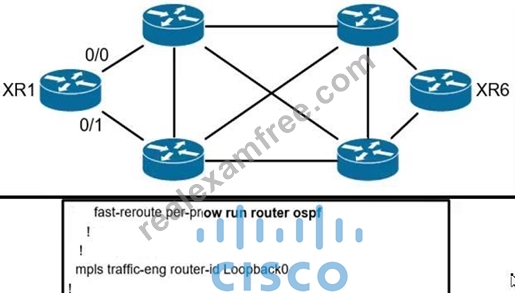
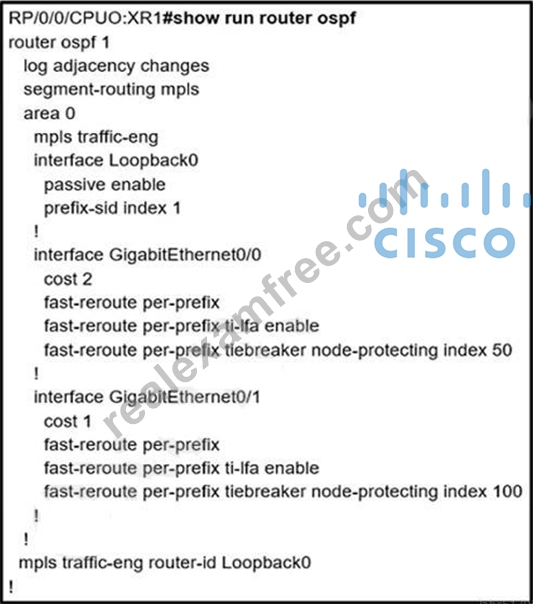
- A. Interface GigabitEthernet 0/0. The tier breaker of the path cost being lower. The node index priority does not impact this selection process.
- B. Interface GigabitEthernet 0/1. The tie breaker of the path cost being lower. The node index priority does not impact this selection process.
- C. Interface GigabitEthernet 0/1. The tie breaker of the node index priority is lower and trumps the path cost.
- D. Interface GigabitElhemet 0/0. The tie breaker of the node index priority is lower and trumps the path cost.
Answer: D
NEW QUESTION # 85
Refer to the exhibit.
Refer to the exhibit. An engineer is troubleshooting an issue with traffic steering using the color-only automated steering mechanism. BGP is failing to automatically steer traffic into an SR policy with the given color of a route, regardless of the next hop. The layer 2 configuration is correct, and the physical connection between the devices is working normally. Whch additional command sequence must the engineer add to correct the issue?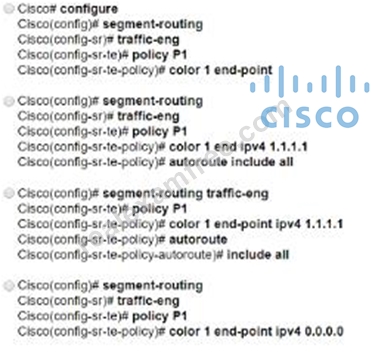
- A. Option D
- B. Option B
- C. Option C
- D. Option A
Answer: A
NEW QUESTION # 86
Refer to the exhibit.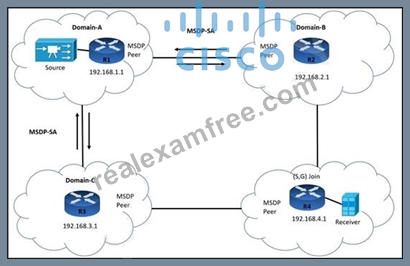
R3 is:
failing to accept multicast RP information from Domain-A
advertising MSDP SA messages to R1 and R4
receiving SA messages only from R4
Which command must the engineer implement to resolve the issue?
- A. R3# no ip msap sa-filter in 192.168.1.1
C R3# no ip msdp peer 192.168.1.1 - B. R3# ip msdp sa-filter out 192.168.1.1
- C. R3# ip msdp sa-filter in 192.168.3.1
Answer: A
NEW QUESTION # 87
Refer to the exhibit.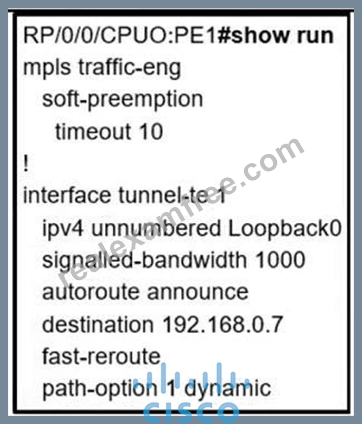
A network operator is troubleshooting TE tunnels and discovers that the soft preemption is not working as desired. Where should the soft preemption be applied to solve the issue?
- A. explicitly for tunnel-te 1 under the Cisco MPLS TE configuration mode after the timeout setting
- B. Under the interface Loopback0 necessary for this deployment type.
- C. under the tunnel-te1 interface on PE1
- D. on the tail-end device for tunnel-te1 192.168.0.7
Answer: C
NEW QUESTION # 88
Compare different features between OSPFv2 and OSPFv3. Drag and drop the descriptions of OSPF from the left onto the correct OSPF versions on the right.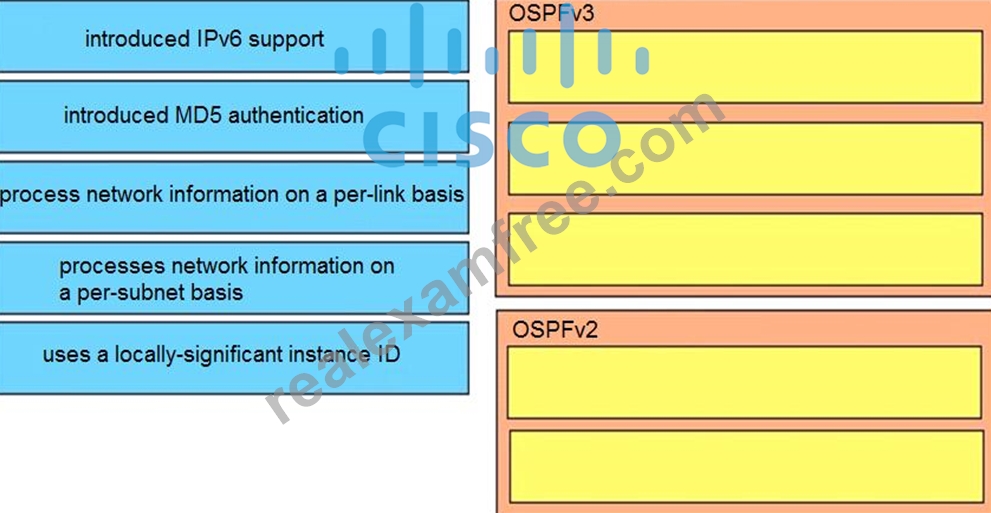
Answer:
Explanation: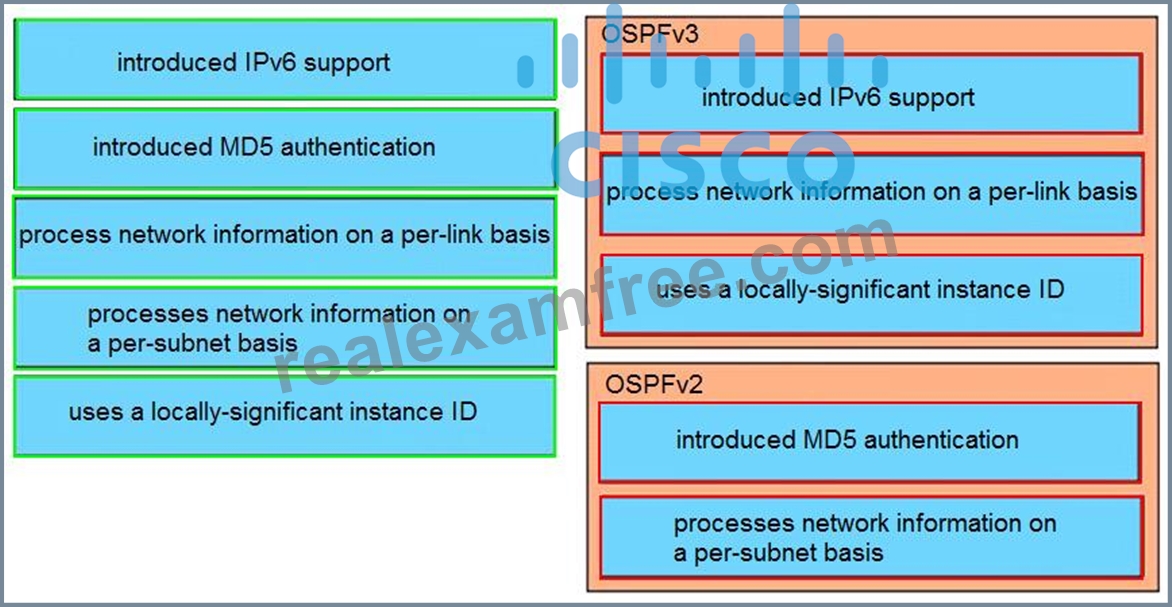
NEW QUESTION # 89
Drag and drop the features from the left into the order of operations for SRv6 SSH field creation and forwarding on the right.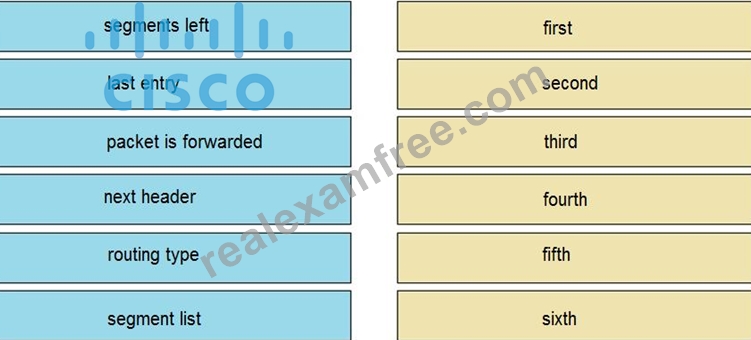
Answer:
Explanation: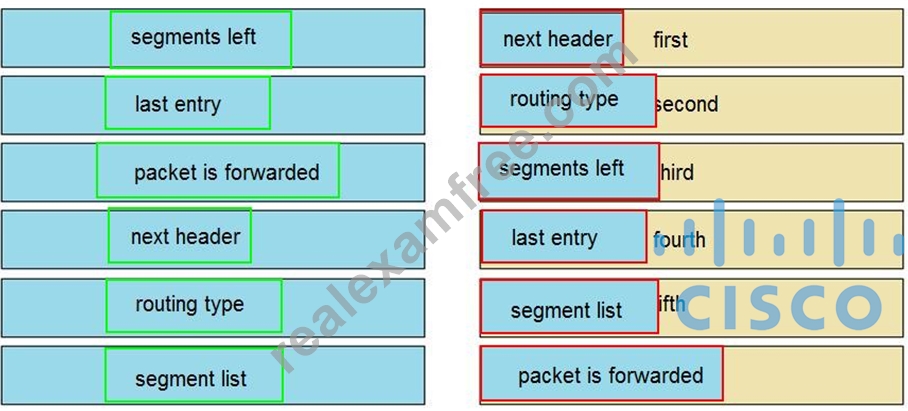
NEW QUESTION # 90
Refer to the exhibit.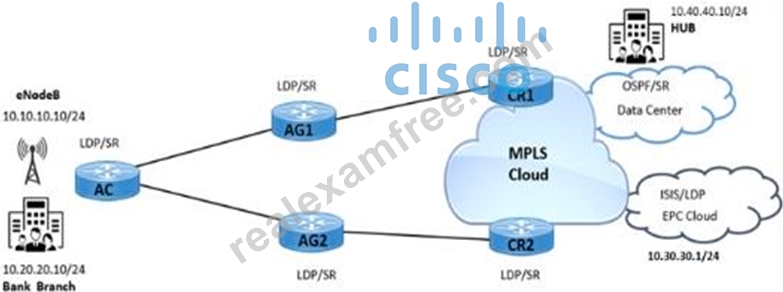
Refer to the exhibit. A service provider has LDP and segment routing running in the network. Mobility traffic is carried through LDP and enterprise traffic is carried through segment routing. Which configuration must be implemented to connect the bank branch with the HUB site on routers?
- A. Enable segment-routing Mpls Sr-prefer on AG1 and AG2 routers for 10.0.0.0/8.
- B. Enable segment-routing Mpls Sr-prefer on CR1 and CR2 routers for 10.0.0.0/8.
- C. Configure segment-routing sr-prefer prefix-list on CR1 and CR2 routers for 10.20.20.10/24.
- D. Configure segment-routing Sr-prefer prefix-list on AG1 and AG2 router for 10.10.10.10/24.
Answer: C
NEW QUESTION # 91
For which reason can two devices fail to establish an OSPF neighbor relationship?
- A. The two devices have the same area ID
- B. The two devices have different network types
- C. The two devices have different router IDs
- D. The two devices have different process IDs
Answer: B
NEW QUESTION # 92 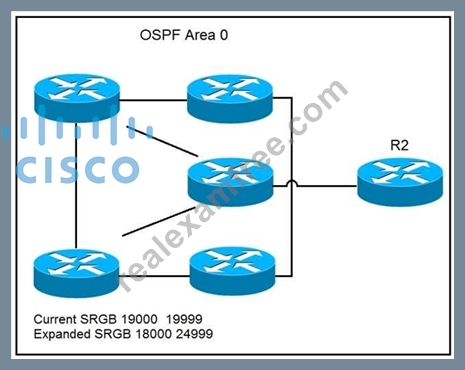
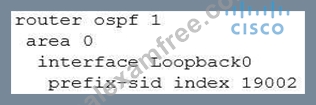
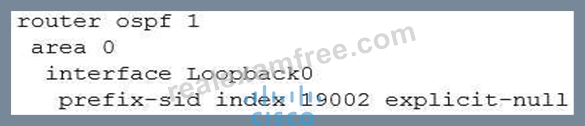
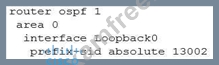
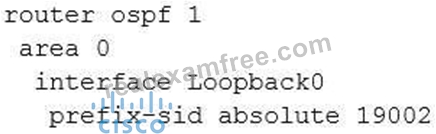
Refer to the exhibit. A network operator wants to expand the segment routing global block in upcoming maintenance. The operator must ensure that the changes to the segment routing global block have no adverse impacts on the prefix-sid associated with the loopback0 interface used within the OSPF domain. Which command can the operator use to enforce R2 to have a strict prefix-sid assignment to loopback0?
- A.
- B.
- C.
- D.
Answer: D
NEW QUESTION # 93
What is the purpose of ACL type prefix set entries in RPL prefix sets?
- A. They hold IPv4 prefixes that do not match specifications.
- B. They hold IPv4 or IPv6 prefix match specifications.
- C. They hold IPv4 or IPv6 prefixes that do not match specifications.
- D. They hold IPv6 prefix match specifications.
Answer: B
NEW QUESTION # 94
Drag and drop the features from the left into the order of operations for SRv6 SSH field creation and forwarding on the right.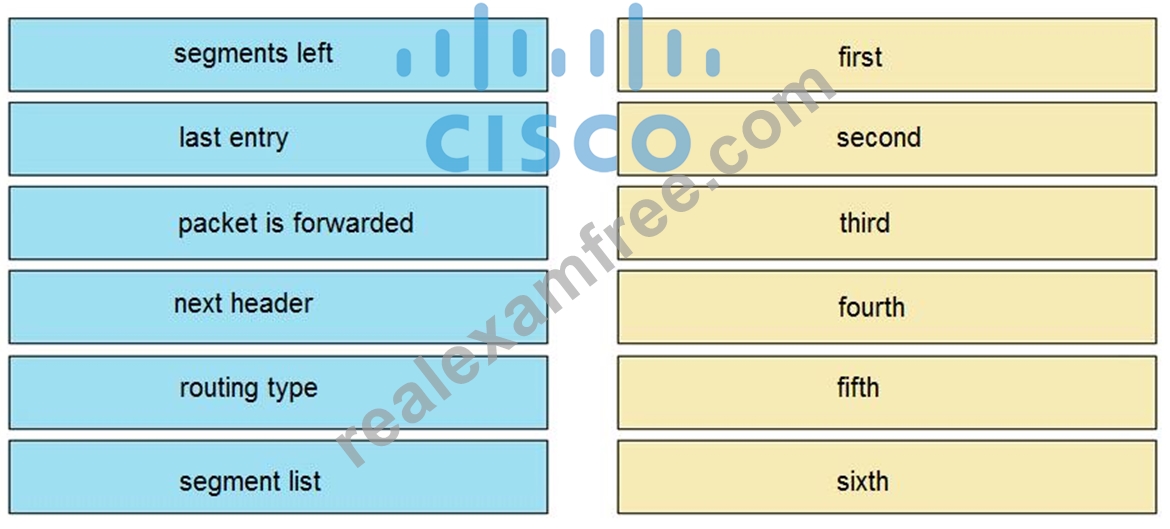
Answer:
Explanation: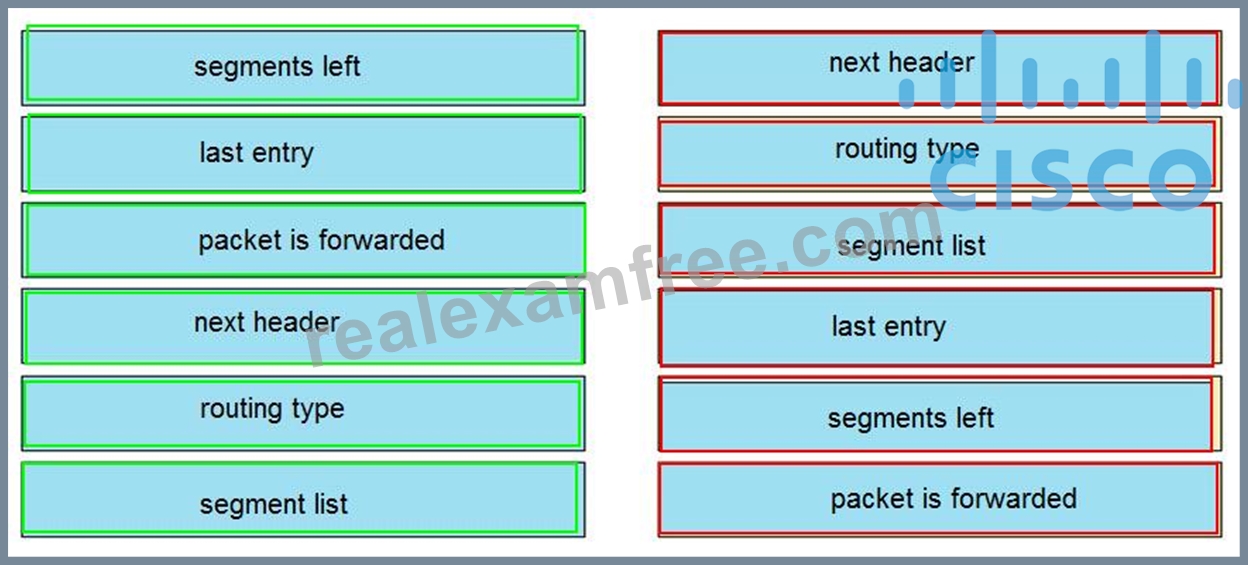
NEW QUESTION # 95
Refer to the exhibit.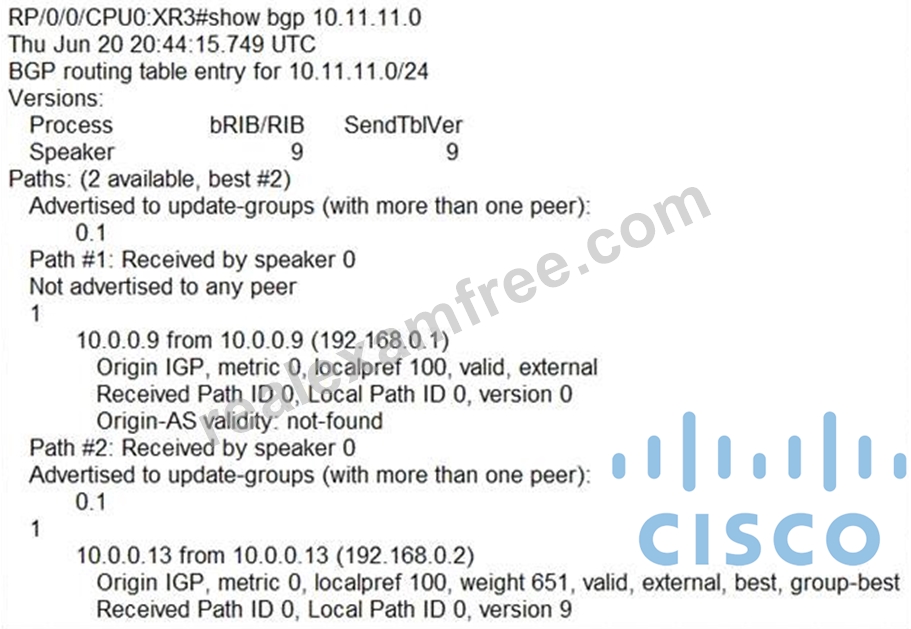
A network operator is getting the route for 10.11.11 0/24 from two upstream providers on
#XR3. The network operator must configure #XR3 to force the 10.11.11.0/24 prefix to route via next hop of
10.0.0.9 as primary when available. Which of these can the operator use the routing policy language for, to enforce this traffic forwarding path?
- A. lower local preference on the prefix coming from 192.168.0.2
- B. weight of 0 on the prefix coming from 192.168.0.2
- C. higher local preference on the prefix coming from 192.168.0.1
- D. weight of 100 on the prefix coming from 192.168.0.1
Answer: B
NEW QUESTION # 96
Refer to the exhibit.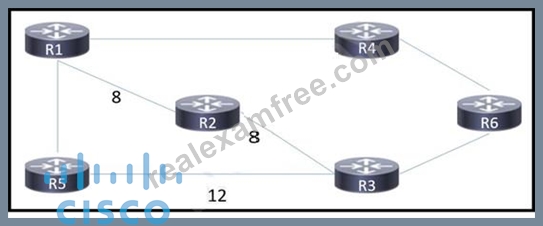
A network engineer configured routers R1 and R5 to run in IS-IS Level 1 mode and router R6 to run in IS-IS Level 2 mode. All other routers are running as Level 1 / Level 2 routers. An engineer expects traffic from R1 to R6 to pass via R2, but IS-IS routing has calculated the best path via R4. Which action corrects the problem?
- A. Configure all routers as Level 1 / Level 2 routers.
- B. Remove the link metric for the link from router R1 to router R2.
- C. Change the link metric for the link from router R1 to router R2 to 1.
- D. Configure all routers as Level 1 routers.
Answer: C
Explanation:
The default link metric for IS-IS is 10, so changing the link from R1 to R2 to 1 will change the overall metric to R6 to 9 (8+1).
NEW QUESTION # 97
Refer to the exhibit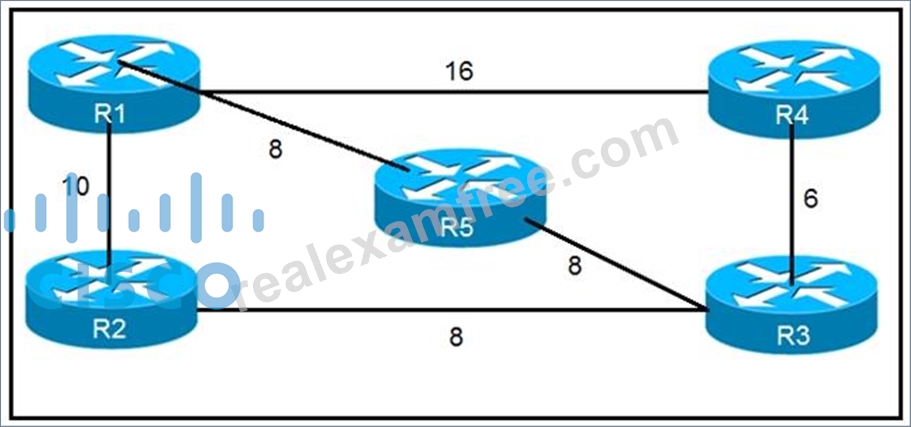
Which router does R1 install as an alternate next hop when trying to reach R3 if LFA is enabled?
- A. R5
- B. R4
- C. R2
- D. R3
Answer: C
NEW QUESTION # 98
Which statement about BFD on Cisco IOS XR Software is true?
- A. Cisco IOS XR router must use LDP to route back to the Cisco IOS router to establish the peer relationship.
- B. Cisco IOS XR router must use dynamic routing or a static route back to the Cisco IOS router to establish the peer relationship.
- C. BFD is not compatible between Cisco IOS XR and Cisco IOS Software.
- D. Cisco IOS XR Software does not support BFD multihop for IPv4.
Answer: B
Explanation:
Reference:
https://www.cisco.com/c/en/us/td/docs/routers/asr9000/software/asr9k-r6-3/routing/configuration/ guide/b-routing-cg-asr9000-63x/b-routing-cg-asr9000-63x_chapter_0100.html
NEW QUESTION # 99
Which two differences should be considered when deciding whether to implement to implement routing policies or route maps? (Choose two.)
- A. Route policies require sequence numbers, but route maps are implemented without sequencing.
- B. Sequences are added after implementing a route map, but routing policies must be reconfigured when change is needed.
- C. Route maps require an explicit deny at the end of the sequence, but routing policies have an implicit deny at the end of the program.
- D. Route maps are supported in Cisco 10S Software and routing policies are supported in Cisco IOS XR Software.
- E. Route maps are implemented using hierarchical policies, but routing policies must be implemented sequentially.
Answer: B,D
NEW QUESTION # 100
Refer to the exhibit.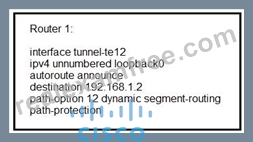
Router 1 has established an SR-TE tunnel with router 2. Which statement describes this configuration?
- A. Router 2 is the head-end tunnel and has explicitly set a path to router 1.
- B. Router 1 has a list of labels used to explicitly lay out a path to router 2.
- C. Router 1 and router 2 have a bidirectional tunnel set up with dynamic path selection.
- D. Router 1 is the head-end tunnel and has dynamically chosen a path to router 2.
Answer: D
NEW QUESTION # 101
An engineer is troubleshooting a connectivity issue across the MPLS network and is verifying the forwarding behavior of packets.
Which table does the engineer look at to verify the forwarding behavior of an IP packet as it enters the MPLS network at the ingress LSR?
- A. FIB
- B. RIB
- C. LFIB
- D. LIB
Answer: C
NEW QUESTION # 102
Refer to the exhibit.
Routers within the cluster are not receiving the desired prefixes. What must be done to fix the issue?
- A. Clients in that cluster must have full mesh connectivity between eBGP peers.
- B. No client-to-client reflection must be enabled.
- C. No client-to-client must be disabled.
- D. Clients in that cluster must have full mesh connectivity between iBGP peers.
Answer: D
NEW QUESTION # 103
......
Updated 300-510 Certification Exam Sample Questions: https://www.realexamfree.com/300-510-real-exam-dumps.html
Get Unlimited Access to 300-510 Certification Exam Cert Guide: https://drive.google.com/open?id=1ZeSxfHr9BBy5Yf_XWPflr5GA2MxkvdMO
