

AZ-400 Practice Exam Tests Latest Updated on Sep-2021
Pass AZ-400 Exam in First Attempt Guaranteed Dumps!
NEW QUESTION 80
Note: This question is part of a series of questions that present the same scenario. Each question in the series contains a unique solution that might meet the stated goals. Some question sets might have more than one correct solution, while others might not have a correct solution.
After you answer a question in this section, you will NOT be able to return to it. As a result, these questions will not appear in the review screen.
Your company uses Azure DevOps to manage the build and release processes for applications.
You use a Git repository for applications source control.
You need to implement a pull request strategy that reduces the history volume in the master branch.
Solution: You implement a pull request strategy that uses an explicit merge.
Does this meet the goal?
- A. No
- B. Yes
Answer: A
Explanation:
Explanation
Instead use fast-forward merge.
Note:
No fast-forward merge - This option merges the commit history of the source branch when the pull request closes and creates a merge commit in the target branch.
Reference:
https://docs.microsoft.com/en-us/azure/devops/repos/git/branch-policies
NEW QUESTION 81
You are implementing an Azure DevOps strategy for mobile devices using App Center.
You plan to use distribution groups to control access to releases.
You need to create the distribution groups shown in the following table.
Which type of distribution group should you use for each group? To answer, drag the appropriate group types to the correct locations. Each group type may be used once, more than once, or not at all. You may need to drag the split bar between panes or scroll to view content.
NOTE: Each correct selection is worth one point.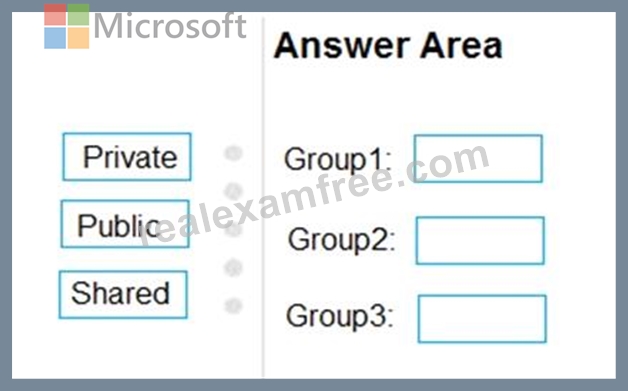
Answer:
Explanation: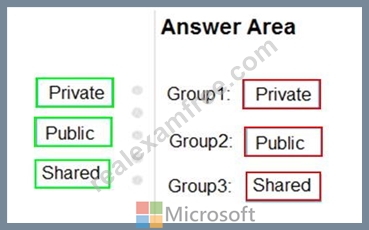
Explanation:
Box1: Private
In App Center, distribution groups are private by default. Only testers invited via email can access the releases available to this group.
Box 2: Public
Distribution groups must be public to enable unauthenticated installs from public links.
Box 3: Shared
Shared distribution groups are private or public distribution groups that are shared across multiple apps in a single organization.
Reference:
https://docs.microsoft.com/en-us/appcenter/distribution/groups
NEW QUESTION 82
Note: This question is part of a series of questions that present the same scenario. Each question in the series contains a unique solution that might meet the stated goals. Some question sets might have more than one correct solution, while others might not have a correct solution.
After you answer a question in this section, you will NOT be able to return to it. As a result, these questions will not appear in the review screen.
The lead developer at your company reports that adding new application features takes longer than expected due to a large accumulated technical debt.
You need to recommend changes to reduce the accumulated technical debt.
Solution: You recommend increasing the code duplication.
Does this meet the goal?
- A. No
- B. Yes
Answer: A
Explanation:
Instead reduce the code complexity.
Note: Technical debt is the accumulation of sub-optimal technical decisions made over the lifetime of an application. Eventually, it gets harder and harder to change things: it's the 'sand in the gears' that sees IT initiatives grind to a halt.
Reference:
https://dzone.com/articles/fight-through-the-pain-how-to-deal-with-technical
https://www.devopsgroup.com/blog/five-ways-devops-helps-with-technical-debt/
NEW QUESTION 83
You currently use JIRA, Jenkins, and Octopus as part of your DevOps processes.
You plan to use Azure DevOps to replace these tools.
Which Azure DevOps service should you use to replace each tool? To answer, select the appropriate options in the answer area.
NOTE: Each correct selection is worth one point.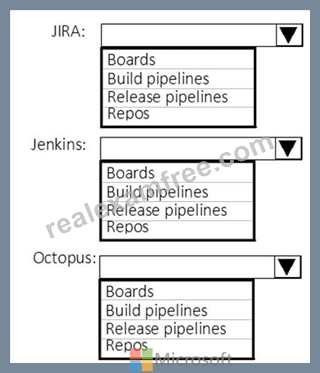
Answer:
Explanation: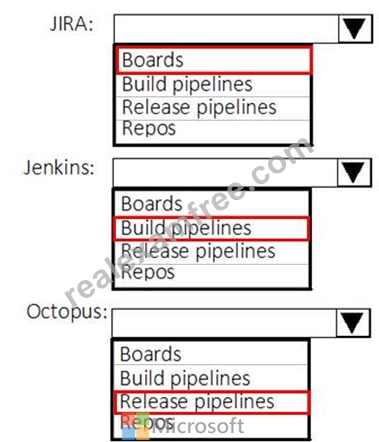
NEW QUESTION 84
What should you use to implement the code quality restriction on the release pipeline for the investment planning applications suite?
- A. a deployment gate
- B. a post-deployment approval
- C. a pre deployment approval
- D. a trigger
Answer: C
Explanation:
When a release is created from a release pipeline that defines approvals, the deployment stops at each point where approval is required until the specified approver grants approval or rejects the release (or re-assigns the approval to another user).
Scenario: Code quality and release quality are critical. During release, deployments must not proceed between stages if any active bugs are logged against the release.
References:
https://docs.microsoft.com/en-us/azure/devops/pipelines/release/approvals/approvals
NEW QUESTION 85
Your company uses a Git repository in Azure Repos lo manage the source code of a web application. The master branch is protected from direct updates. Developers work on new features in the topic branches.
Because of the high volume of requested features, it is difficult to follow the history of the changes to the master branch.
You need to enforce a pull request merge strategy. The strategy must meet the following requirements:
* Consolidate commit histories
* Merge tie changes into a tingle commit
Which merge strategy should you use in the branch policy?
- A. fast-forward merge
- B. Git fetch
- C. no-fast-forward merge
- D. squash merge
Answer: D
Explanation:
Squash merging is a merge option that allows you to condense the Git history of topic branches when you complete a pull request. Instead of each commit on the topic branch being added to the history of the default branch, a squash merge takes all the file changes and adds them to a single new commit on the default branch.
A simple way to think about this is that squash merge gives you just the file changes, and a regular merge gives you the file changes and the commit history.
Note: Squash merging keeps your default branch histories clean and easy to follow without demanding any workflow changes on your team. Contributors to the topic branch work how they want in the topic branch, and the default branches keep a linear history through the use of squash merges. The commit history of a master branch updated with squash merges will have one commit for each merged branch. You can step through this history commit by commit to find out exactly when work was done.
References: https://docs.microsoft.com/en-us/azure/devops/repos/git/merging-with-squash
NEW QUESTION 86
You have an Azure DevOps project that contains a build pipeline. The build pipeline uses approximately 50 open source libraries.
You need to ensure that the project can be scanned for known security vulnerabilities in the open source libraries.
What should you do? To answer, select the appropriate options in the answer area.
NOTE: Each correct selection is worth one point.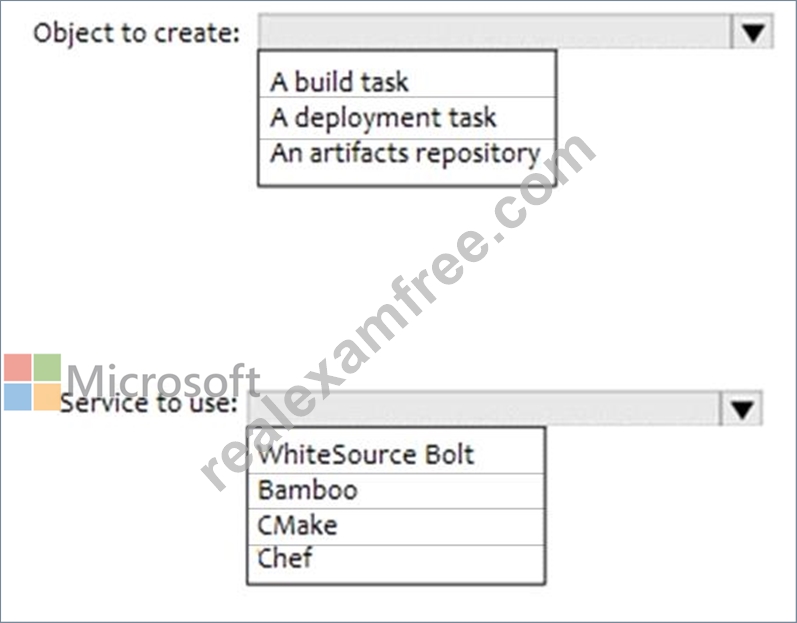
Answer:
Explanation: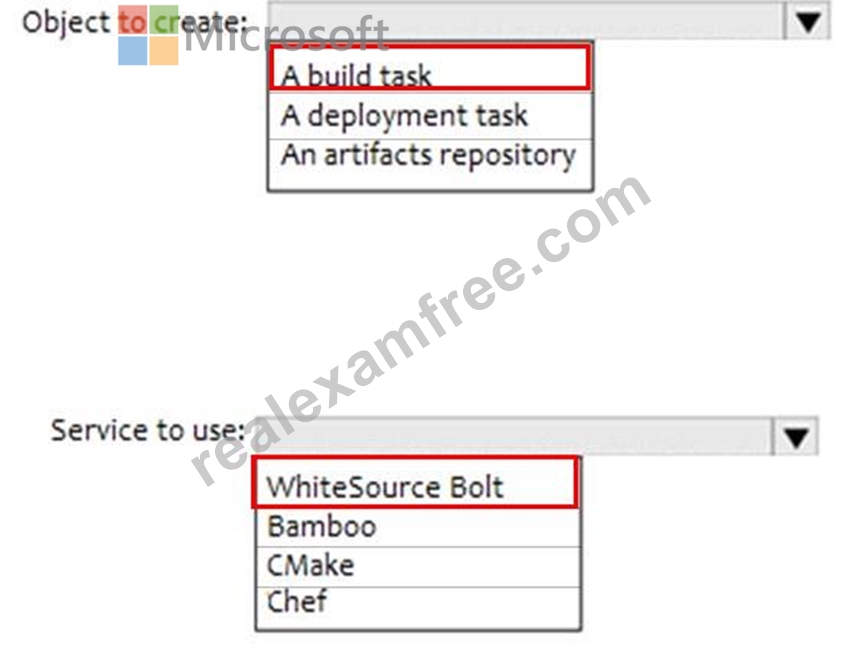
References:
https://www.azuredevopslabs.com/labs/vstsextend/whitesource/
NEW QUESTION 87
Your company has an Azure subscription.
The company requires that all resource group in the subscription have a tag named organization set to a value of Contoso.
You need to implement a policy to meet the tagging requirement.
How should you complete the policy? To answer, select the appropriate options in the answer area.
NOTE: Each correct selection is worth one point.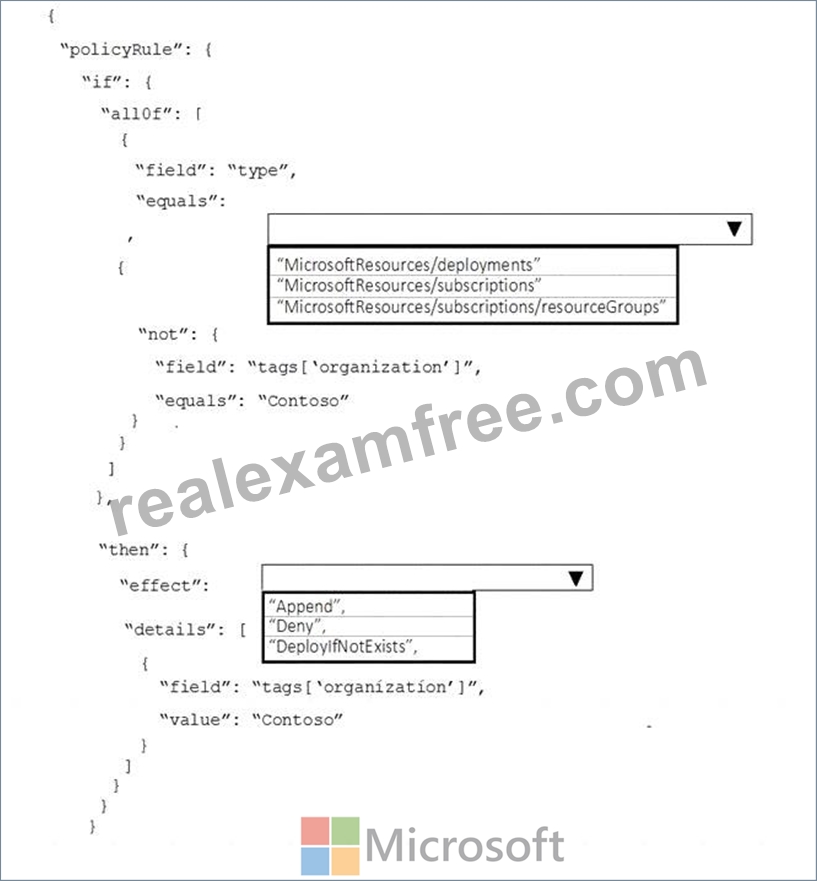
Answer:
Explanation: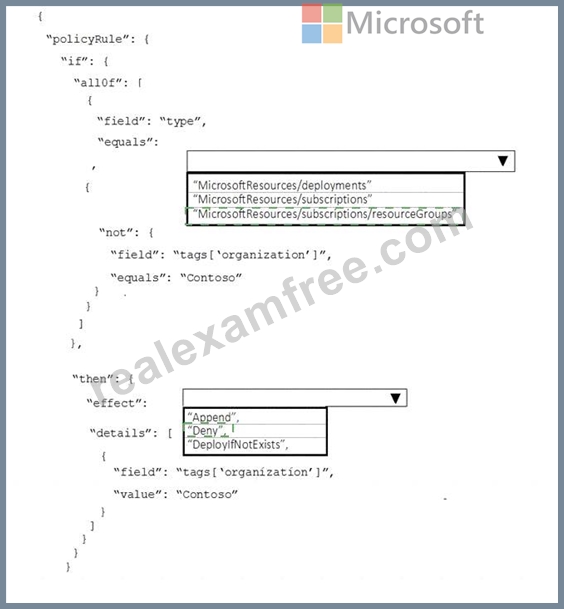
Explanation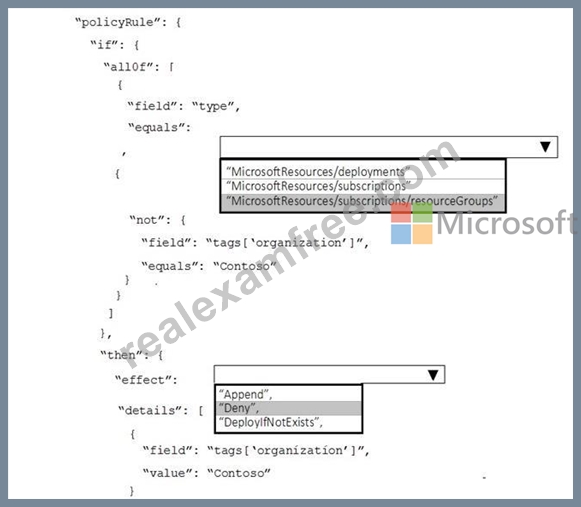
Box 1: " Microsoft.Resources/subscriptions/resourceGroups"
Box 2: "Deny",
Sample - Enforce tag and its value on resource groups
},
"policyRule": {
"if": {
"allOf": [
{
"field": "type",
"equals": "Microsoft.Resources/subscriptions/resourceGroups"
},
{
"not": {
"field": "[concat('tags[',parameters('tagName'), ']')]",
"equals": "[parameters('tagValue')]"
}
}
]
},
"then": {
"effect": "deny"
}
}
}
}
References:
https://docs.microsoft.com/en-us/azure/governance/policy/samples/enforce-tag-on-resource-groups
NEW QUESTION 88
After you answer a question in this section, you will NOT be able to return to it As a result, these questions will not appear in the review screen.
You use Azure Pipelines to build and test a React js application
You have a pipeline that has a single job.
You discover that installing JavaScript packages from npm lakes approximately five minutes each time you run the pipeline.
You need to recommend a solution to reduce the pipeline execution time.
Solution: You recommend enabling pipeline caching.
Does this meet the goal?
- A. No
- B. Yes
Answer: B
Explanation:
npm-cache is a command line utility that caches dependencies installed via npm, bower, jspm and composer.
It is useful for build processes that run [npm|bower|composer|jspm] install every time as part of their build process. Since dependencies don't change often, this often means slower build times. npm-cache helps alleviate this problem by caching previously installed dependencies on the build machine.
Reference:
https://www.npmjs.com/package/npm-cache
NEW QUESTION 89
Your company has a project in Azure DevOps.
You plan to create a release pipeline that will deploy resources by using Azure Resource Manager templates.
The templates will reference secrets stored in Azure Key Vault.
You need to recommend a solution for accessing the secrets stored in the key vault during deployments. The solution must use the principle of least privilege.
What should you include in the recommendation? To answer, drag the appropriate configurations to the correct targets. Each configuration may be used once, more than once, or not at all. You may need to drag the split bar between panes or scroll to view content.
NOTE: Each correct selection is worth one point.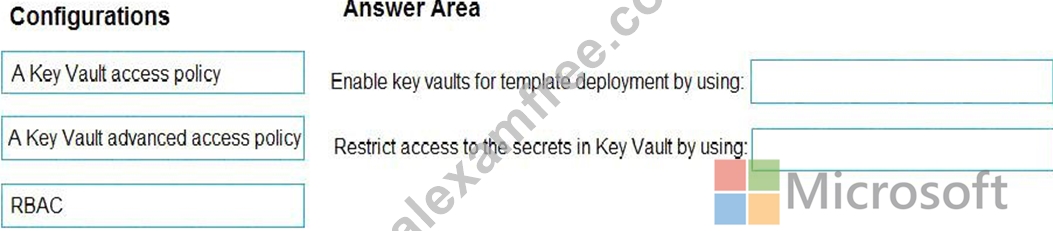
Answer:
Explanation: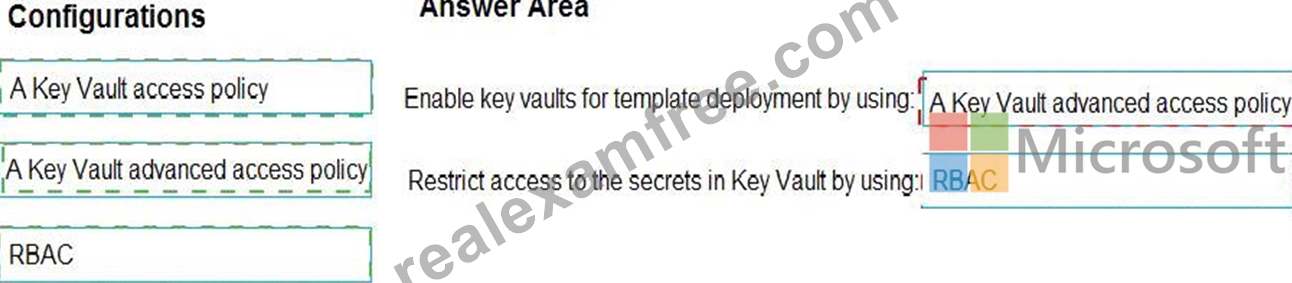
Explanation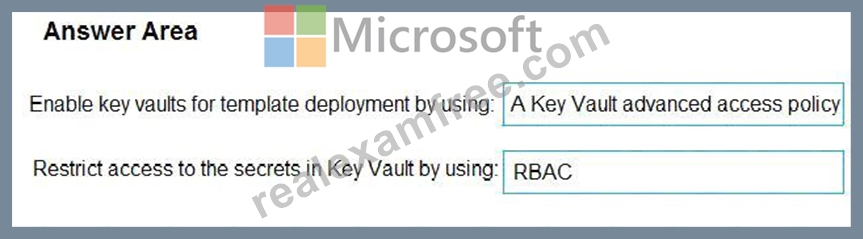
Box 1: A key Vault advanced access policy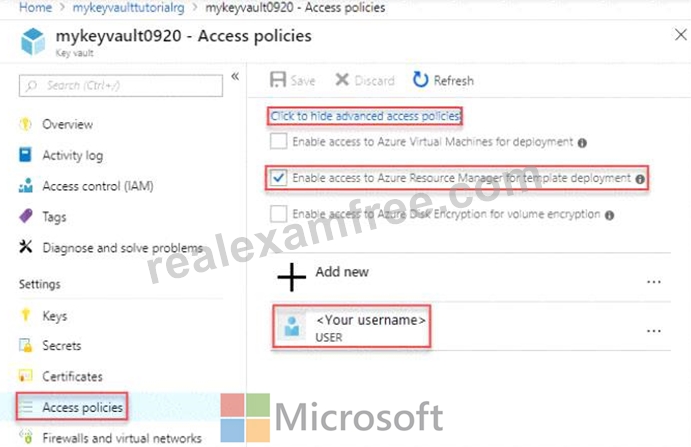
Box 2: RBAC
Management plane access control uses RBAC.
The management plane consists of operations that affect the key vault itself, such as:
* Creating or deleting a key vault.
* Getting a list of vaults in a subscription.
* Retrieving Key Vault properties (such as SKU and tags).
* Setting Key Vault access policies that control user and application access to keys and secrets.
References:
https://docs.microsoft.com/en-us/azure/azure-resource-manager/resource-manager-tutorial-use-key-vault
NEW QUESTION 90
How should you configure the release retention policy for the investment planning applications suite? To answer, select the appropriate options in the answer area.
NOTE: Each correct selection is worth one point.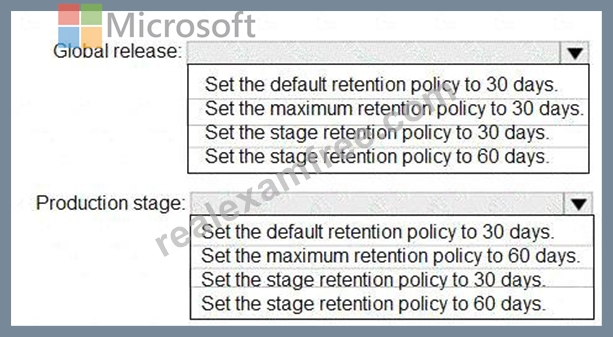
Answer:
Explanation: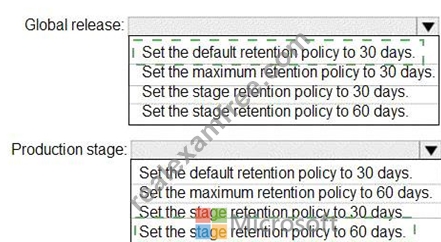
Explanation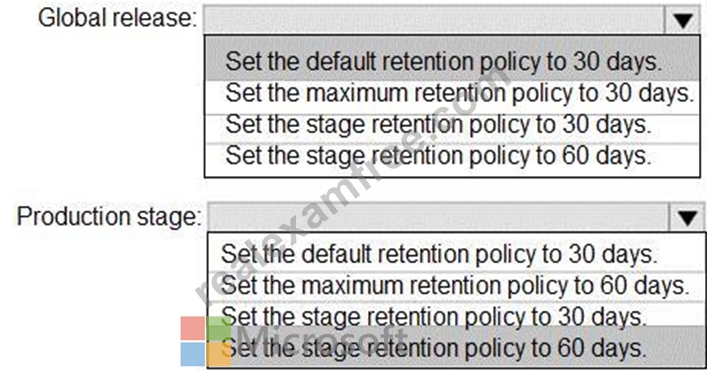
Scenario: By default, all releases must remain available for 30 days, except for production releases, which must be kept for 60 days.
Box 1: Set the default retention policy to 30 days
The Global default retention policy sets the default retention values for all the build pipelines. Authors of build pipelines can override these values.
Box 2: Set the stage retention policy to 60 days
You may want to retain more releases that have been deployed to specific stages.
References: https://docs.microsoft.com/en-us/azure/devops/pipelines/policies/retention
NEW QUESTION 91
Your development team is building a new web solution by using the Microsoft Visual Studio integrated development environment (IDE).
You need to make a custom package available to all the developers. The package must be managed centrally, and the latest version must be available for consumption in Visual Studio automatically.
Which three actions should you perform? Each correct answer presents part of the solution.
NOTE: Each correct selection is worth one point.
- A. Add the package URL to the NuGet Package Manager settings in Visual Studio.
- B. Add the package URL to the Environment settings in Visual Studio.
- C. Create a Git repository in Azure Repos.
- D. Publish the package to a feed.
- E. Create a new feed in Azure Artifacts.
- F. Upload a package to a Git repository.
Answer: A,D,E
Explanation:
Explanation/Reference:
Explanation:
B: By using your custom NuGet package feed within your Azure DevOps (previously VSTS) instance, you'll be able to distribute your packages within your organization with ease.
Start by creating a new feed.
A: We can publish, pack and push the built project to our NuGet feed.
E: Consume your private NuGet Feed
Go back to the Packages area in Azure DevOps, select your feed and hit "Connect to feed". You'll see some instructions for your feed, but it's fairly simple to set up.
Just copy your package source URL, go to Visual Studio, open the NuGet Package Manager, go to its settings and add a new source. Choose a fancy name, insert the source URL. Done.
Search for your package in the NuGet Package Manager and it should appear there, ready for installation.
Make sure to select the appropriate feed (or just all feeds) from the top right select box.
References:
https://medium.com/medialesson/get-started-with-private-nuget-feeds-in-azure-devops-8c7b5f022a68 Testlet 1 Case Study This is a case study. Case studies are not timed separately. You can use as much exam time as you would like to complete each case. However, there may be additional case studies and sections on this exam. You must manage your time to ensure that you are able to complete all questions included on this exam in the time provided.
To answer the questions included in a case study, you will need to reference information that is provided in the case study. Case studies might contain exhibits and other resources that provide more information about the scenario that is described in the case study. Each question is independent of the other question on this case study.
At the end of this case study, a review screen will appear. This screen allows you to review your answers and to make changes before you move to the next section of the exam. After you begin a new section, you cannot return to this section.
To start the case study
To display the first question on this case study, click the Next button. Use the buttons in the left pane to explore the content of the case study before you answer the questions. Clicking these buttons displays information such as business requirements, existing environment, and problem statements. If the case study has an All Information tab, note that the information displayed is identical to the information displayed on the subsequent tabs. When you are ready to answer a question, click the Question button to return to the question.
Overview
Litware, Inc. is an independent software vendor (ISV). Litware has a main office and five branch offices.
Existing Environment
Application Architecture
The company's primary application is a single monolithic retirement fund management system based on ASP.NET web forms that use logic written in VB.NET. Some new sections of the application are written in C#.
Variations of the application are created for individual customers. Currently, there are more than 80 live code branches in the application's code base.
The application was developed by using Microsoft Visual Studio. Source code is stored in Team Foundation Server (TFS) in the main office. The branch offices access the source code by using TFS proxy servers.
Architectural Issues
Litware focuses on writing new code for customers. No resources are provided to refactor or remove existing code. Changes to the code base take a long time, as dependencies are not obvious to individual developers.
Merge operations of the code often take months and involve many developers. Code merging frequently introduces bugs that are difficult to locate and resolve.
Customers report that ownership costs of the retirement fund management system increase continually.
The need to merge unrelated code makes even minor code changes expensive.
Customers report that bug reporting is overly complex.
Requirements
Planned changes
Litware plans to develop a new suite of applications for investment planning. The investment planning applications will require only minor integration with the existing retirement fund management system.
The investment planning applications suite will include one multi-tier web application and two iOS mobile applications. One mobile application will be used by employees; the other will be used by customers.
Litware plans to move to a more agile development methodology. Shared code will be extracted into a series of packages.
Litware has started an internal cloud transformation process and plans to use cloud-based services whenever suitable.
Litware wants to become proactive in detecting failures, rather than always waiting for customer bug reports.
Technical requirements
The company's investment planning applications suite must meet the following requirements:
New incoming connections through the firewall must be minimized.
Members of a group named Developers must be able to install packages.
The principle of least privilege must be used for all permission assignments.
A branching strategy that supports developing new functionality in isolation must be used.
Members of a group named Team Leaders must be able to create new packages and edit the
permissions of package feeds.
Visual Studio App Center must be used to centralize the reporting of mobile application crashes and
device types in use.
By default, all releases must remain available for 30 days, except for production releases, which must
be kept for 60 days.
Code quality and release quality are critical. During release, deployments must not proceed between
stages if any active bugs are logged against the release.
The mobile applications must be able to call the share pricing service of the existing retirement fund
management system. Until the system is upgraded, the service will only support basic authentication over HTTPS.
The required operating system configuration for the test servers changes weekly. Azure Automation
State Configuration must be used to ensure that the operating system on each test server is configured the same way when the servers are created and checked periodically.
Current Technical Issue
The test servers are configured correctly when first deployed, but they experience configuration drift over time. Azure Automation State Configuration fails to correct the configurations.
Azure Automation State Configuration nodes are registered by using the following command.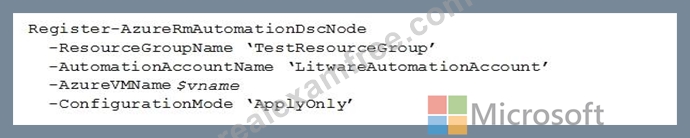
NEW QUESTION 92
You are configuring an Azure DevOps deployment pipeline. The deployed application will authenticate to a web service by using a secret stored in an Azure key vault.
You need to use the secret in the deployment pipeline.
Which three actions should you perform in sequence? To answer, move the appropriate actions from the list of actions to the answer area and arrange them in the correct order.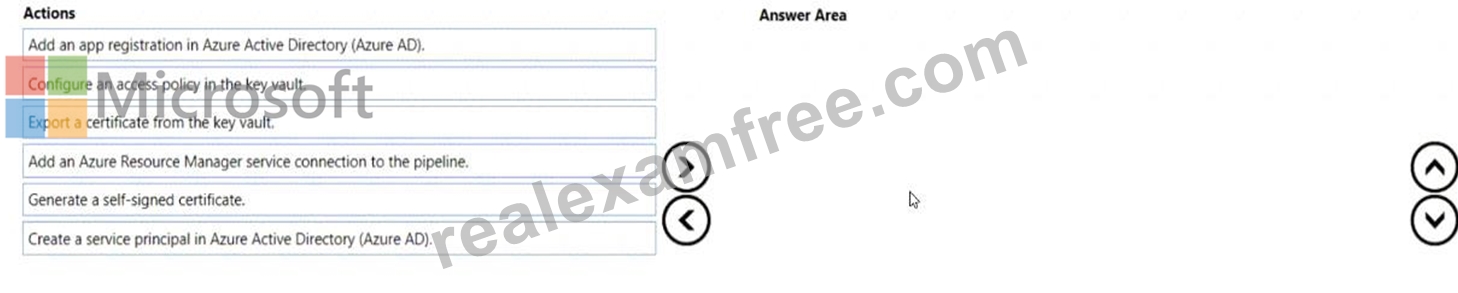
Answer:
Explanation: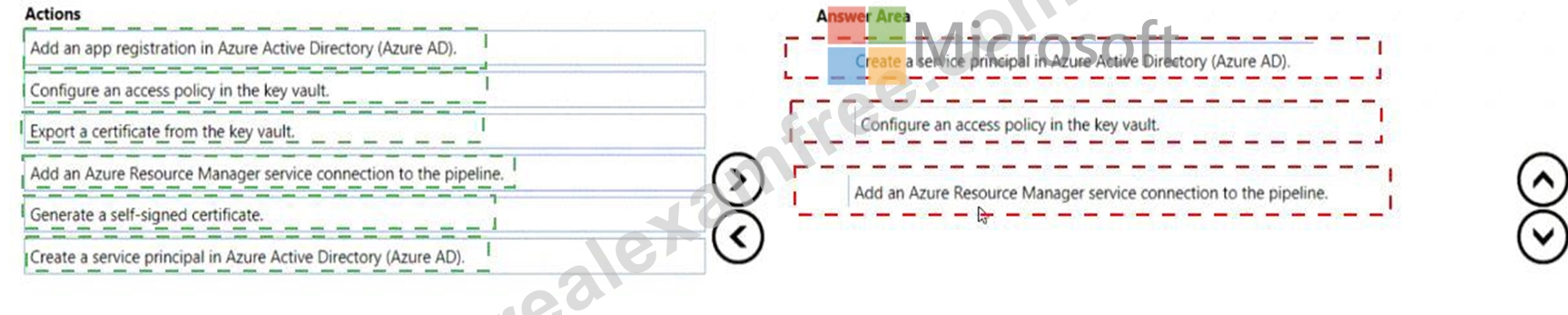
Explanation
Creating a service principal
Creating a key vault
Check the Azure Pipeline
NEW QUESTION 93
You are configuring the settings of a new Git repository in Azure Repos.
You need to ensure that pull requests in a branch meet the following criteria before they are merged:
Committed code must compile successfully.
Pull requests must have a Quality Gate status of Passed in SonarCloud.
Which policy type should you configure for each requirement? To answer, drag the appropriate policy types to the correct requirements. Each policy type may be used once, more than once, or not at all. You may need to drag the split bar between panes or scroll to view content.
NOTE: Each correct selection is worth one point.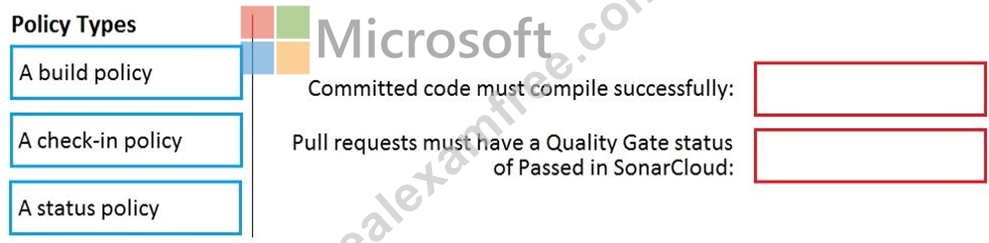
Answer:
Explanation: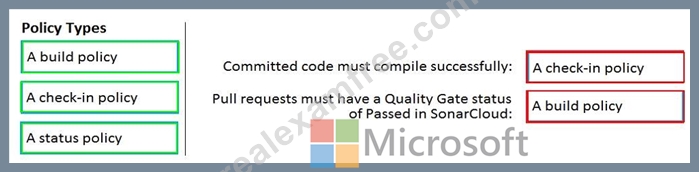
Reference:
https://docs.microsoft.com/en-us/azure/devops/repos/tfvc/add-check-policies
https://azuredevopslabs.com/labs/vstsextend/sonarcloud/
NEW QUESTION 94
Your company plans to implement a new compliance strategy that will require all Azure web apps to be backed up every five hours.
You need to back up an Azure web app named az400-11566895-main every five hours to an Azure Storage account in your resource group.
To complete this task, sign in to the Microsoft Azure portal.
Answer:
Explanation:
See solution below.
Explanation
With the storage account ready, you can configure backs up in the web app or App Service.
* Open the App Service az400-11566895-main, which you want to protect, in the Azure Portal and browse to Settings > Backups. Click Configure and a Backup Configuration blade should appear.
* Select the storage account.
* Click + to create a private container. You could name this container after the web app or App Service.
* Select the container.
* If you want to schedule backups, then set Scheduled Backup to On and configure a schedule: every five hours
* Select your retention. Note that 0 means never delete backups.
* Decide if at least one backup should always be retained.
* Choose if any connected databases should be included in the web app backup.
* Click Save to finalize the backup configuration.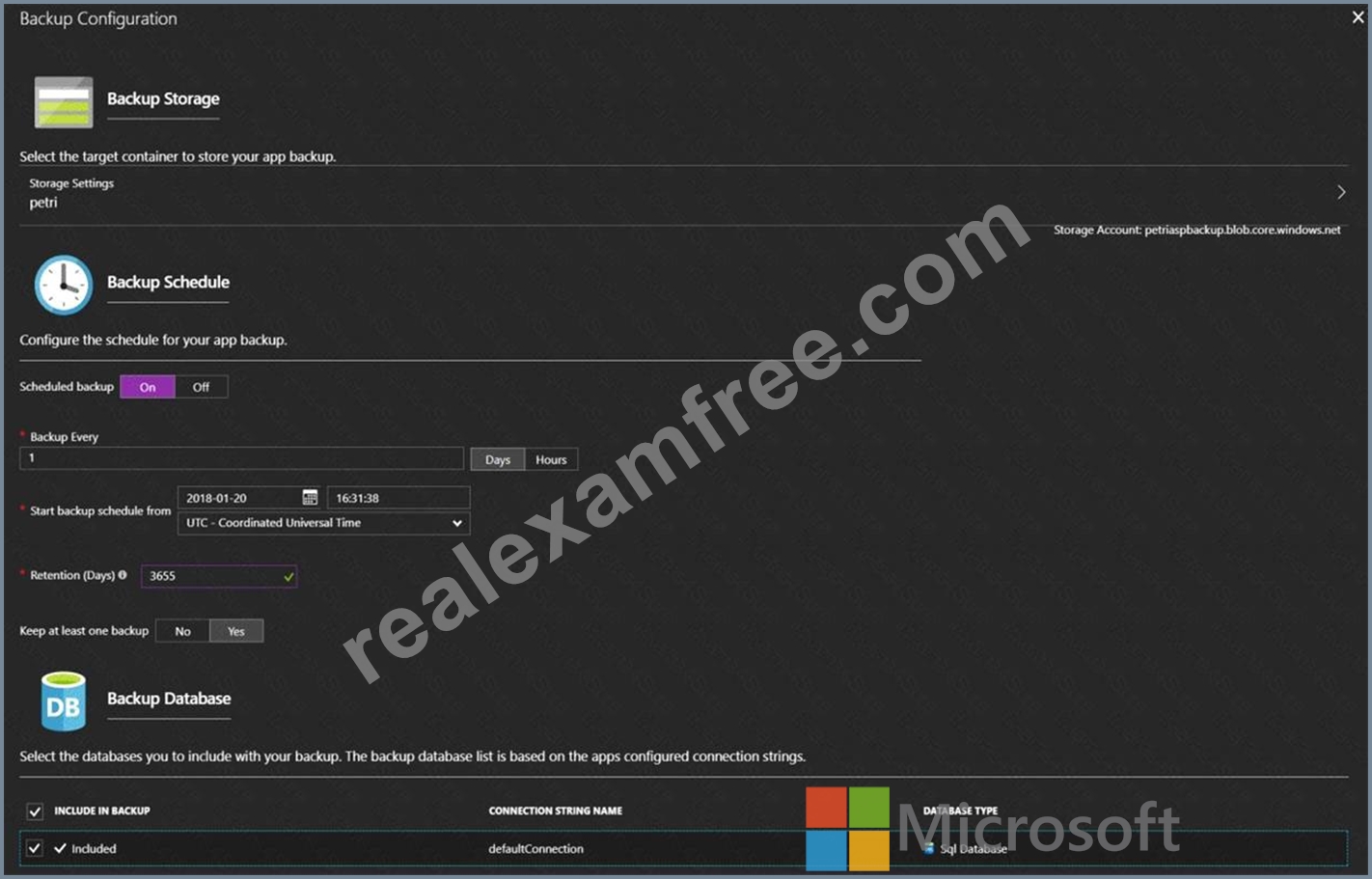
Reference:
https://petri.com/backing-azure-app-service
NEW QUESTION 95
You configure an Azure Application Insights availability test.
You need to notify the customer services department at your company by email when availability is degraded.
You create an Azure logic app that will handle the email and follow up actions.
Which type of trigger should you use to invoke the logic app?
- A. an HTTP trigger
- B. a Request trigger
- C. an ApiConnection trigger
- D. an HTTPWebhook trigger
Answer: D
Explanation:
You can use webhooks to route an Azure alert notification to other systems for post-processing or custom actions. You can use a webhook on an alert to route it to services that send SMS messages, to log bugs, to notify a team via chat or messaging services, or for various other actions.
Reference:
https://docs.microsoft.com/en-us/azure/azure-monitor/platform/alerts-webhooks
NEW QUESTION 96
You need to create an instance of Azure Application Insights named az400-9940427-main and configure the instance to receive telemetry data from an Azure web app named az400-9940427-main.
To complete this task, sign in to the Microsoft Azure portal.
Answer:
Explanation:
See solution below.
Explanation
Step 1: Create an instance of Azure Application Insights
1. Open Microsoft Azure Portal
2. Log into your Azure account, Select Create a resource > Developer tools > Application Insights.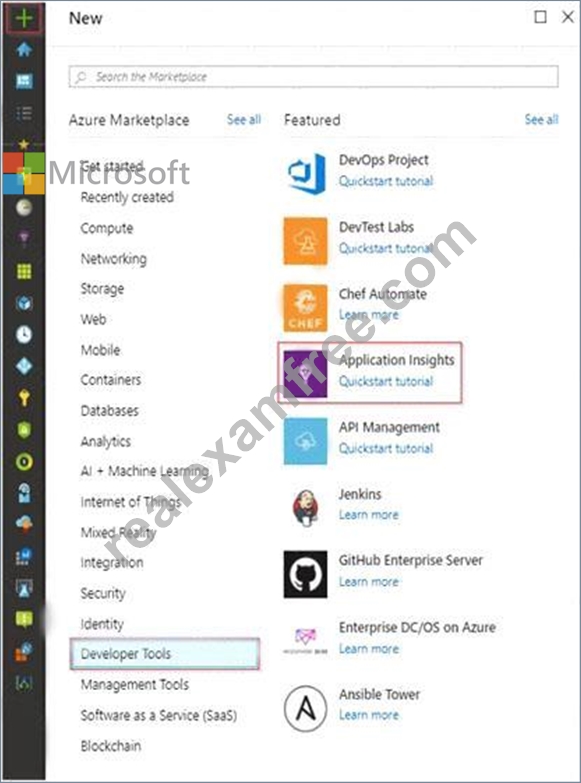
3. Enter the following settings, and then select Review + create.
Name: az400-9940427-main
Step 2: Configure App Insights SDK
4. Open your ASP.NET Core Web App project in Visual Studio > Right-click on the AppName in the Solution Explorer > Select Add > Application Insights Telemetry.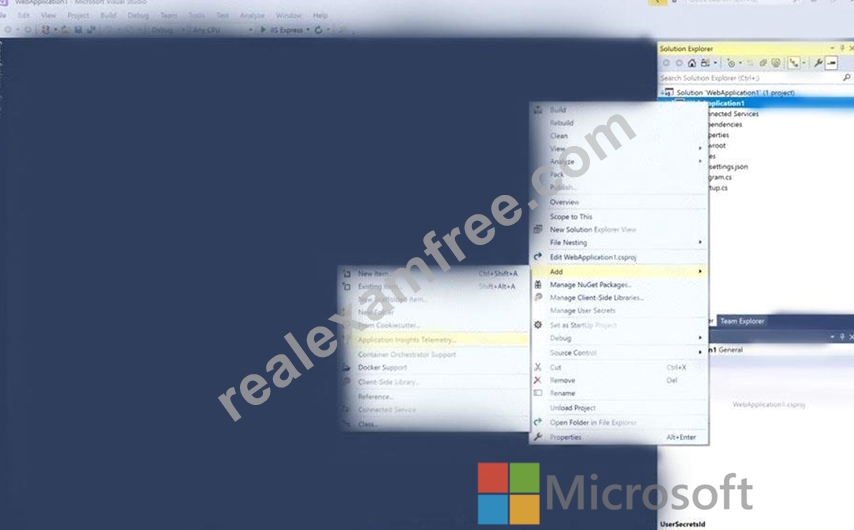
5. Click the Get Started button
6. Select your account and subscription > Select the Existing resource you created in the Azure portal > Click Register.
References:
https://docs.microsoft.com/bs-latn-ba/azure/azure-monitor/learn/dotnetcore-quick-start?view=vs-2017
NEW QUESTION 97
You have a web app hosted on Azure App Service. The web app stores data in an Azure SQL database.
You need to generate an alert when there are 10,000 simultaneous connections to the database. The solution must minimize development effort.
Which option should you select in the Diagnostics settings of the database?
- A. Archive to a storage account
- B. Stream to an event hub
- C. Send to Log Analytics
Answer: C
Explanation:
ENABLE DIAGNOSTICS TO LOG ANALYTICS
This configuration is done PER DATABASE
1. Click on Diagnostics Settings and then Turn On Diagnostics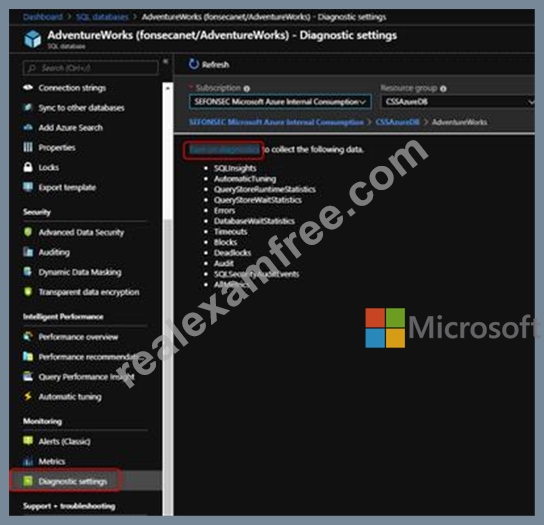
2. Select to Send to Log Analytics and select the Log Analytics workspace. For this sample I will selected only Errors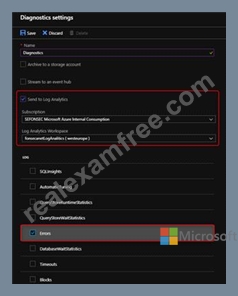
Reference:
https://techcommunity.microsoft.com/t5/azure-database-support-blog/azure-sql-db-and-log-analytics-better-together-part-1/ba-p/794833
NEW QUESTION 98
Note: This question is part of a series of questions that present the same scenario. Each question in the series contains a unique solution that might meet the stated goals. Some question sets might have more than one correct solution, while others might not have a correct solution.
After you answer a question in this section, you will NOT be able to return to it. As a result, these questions will not appear in the review screen.
You need to recommend an integration strategy for the build process of a Java application. The solution must meet the following requirements:
* The builds must access an on-premises dependency management system.
* The build outputs must be stored as Server artifacts in Azure DevOps.
* The source code must be stored in a Git repository in Azure DevOps.
Solution: Configure the build pipeline to use a Hosted Ubuntu agent pool. Include the Java Tool Installer task in the build pipeline. Does this meet the goal?
- A. No
- B. Yes
Answer: B
NEW QUESTION 99
You have a project in Azure DevOps named Contoso App that contains pipelines in Azure Pipelines for GitHub repositories. You need to ensure that developers receive Microsoft Teams notifications when there are failures in a pipeline of Contoso App. What should you run in Teams? To answer, select the appropriate options in the answer are a. NOTE: Each correct selection is worth one point.
Answer:
Explanation:
NEW QUESTION 100
Your company is building a new web application.
You plan to collect feedback from pilot users on the features being delivered.
All the pilot users have a corporate computer that has Google Chrome and the Microsoft Test & Feedback extension installed. The pilot users will test the application by using Chrome.
You need to identify which access levels are required to ensure that developers can request and gather feedback from the pilot users. The solution must use the principle of least privilege.
Which access levels m Azure DevOps should you identify? To answer, select the appropriate options in the answer area NOTE: Each correct selection is worth one point.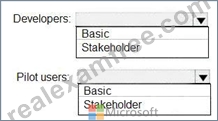
Answer:
Explanation: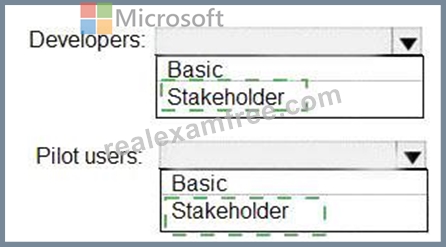
Explanation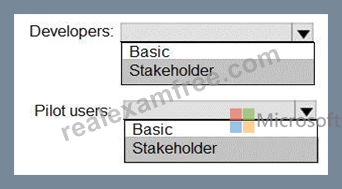
Box 1: Basic
Assign Basic to users with a TFS CAL, with a Visual Studio Professional subscription, and to users for whom you are paying for Azure Boards & Repos in an organization.
Box 2: Stakeholder
Assign Stakeholders to users with no license or subscriptions who need access to a limited set of features.
Note:
You assign users or groups of users to one of the following access levels:
Basic: provides access to most features
VS Enterprise: provides access to premium features
Stakeholders: provides partial access, can be assigned to unlimited users for free References: https://docs.microsoft.com/en-us/azure/devops/organizations/security/access-levels?view=vsts
NEW QUESTION 101
......
Microsoft Azure Free Certification Exam Material from RealExamFree with 329 Questions: https://www.realexamfree.com/AZ-400-real-exam-dumps.html
AZ-400 Dumps Full Questions - Exam Study Guide: https://drive.google.com/open?id=16umNpx1VApGcJvpeh_9jTCcdgEcVrmm6
